The Real Cost of a Phantom SKU: How One Brand Found $20K in Lost Product for $1K
Here's a story that should make every brand founder slightly nauseous, because the worst part isn't the money. The worst part is how long nobody noticed.
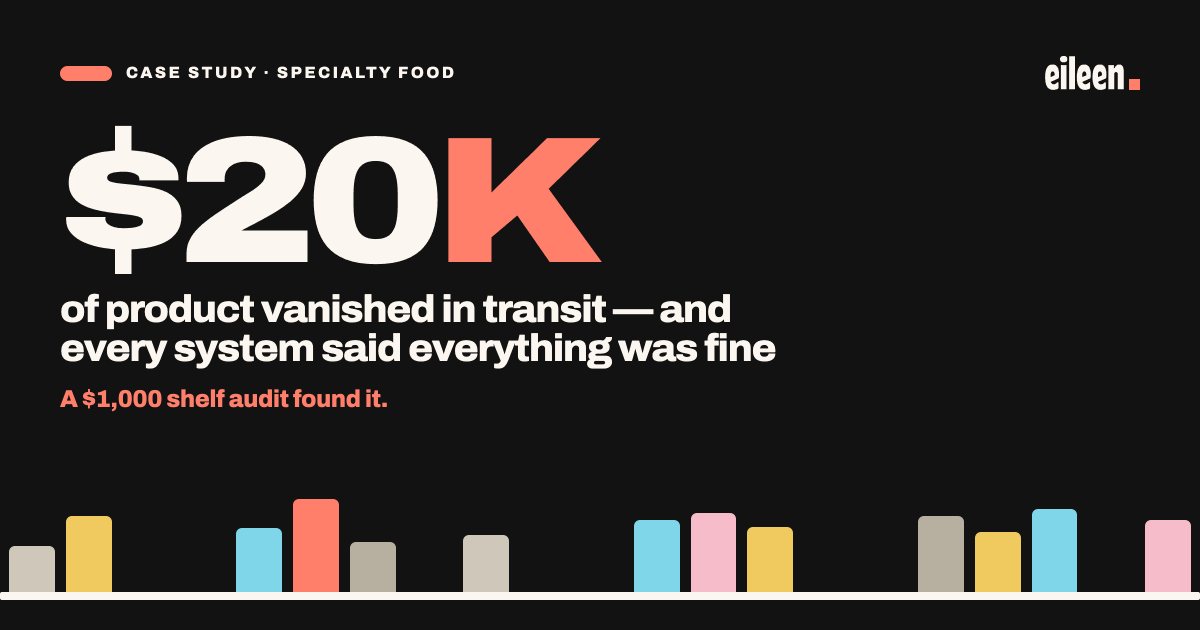
A specialty food brand we work with had a pallet of product headed to a grocery retailer. Roughly $20,000 worth. Somewhere between the distributor's warehouse and the store, the pallet disappeared. Lost in transit. It happens.
What happened next is the part that matters.
The distributor billed the brand for the pallet anyway. The retailer, who never received the product, quietly faced the empty shelf space over with a competitor's product. And the brand went on with its quarter, completely unaware, because every system it relied on said everything was fine.
Three systems, three lies
Walk through what the brand's own data showed during those months.
The inventory system showed the product as shipped. From where the brand sat, the pallet went out the door and the invoice matched. Done.
The depletion report showed zero velocity at those locations. Concerning, but depletion reports don't tell you why something isn't selling. They just tell you it isn't.
The BI dashboard took that zero velocity and read it the only way it could: zero demand. No alert fired. No exception report flagged it. The software did exactly what it was designed to do, which is interpret the numbers it's given. Nobody designed it to ask whether the product physically existed on a shelf.
So the official story, assembled from three expensive systems, was this: we shipped product to stores where consumers don't want it. The logical next move would have been to pull back from those locations. The brand was a few reporting cycles away from making a distribution decision based on a pallet that fell off the map.
That's a phantom SKU. Product that exists everywhere in the data and nowhere in the store.
How it actually got caught
Not by an audit of the data. By an audit of the shelf.
The brand ran a standard Eileen shelf audit. Everyday shoppers walked into the stores, photographed the section, and the SKU came back missing from a suspiciously high percentage of locations. Not low stock. Not bad placement. Missing.
That's the finding that doesn't fit the "weak demand" story. Weak demand looks like product sitting on a shelf. It doesn't look like no product at all. One photo of an empty slot reframes the entire conversation, because now the question isn't "why isn't this selling" but "where is it."
Pull that thread and the whole thing unravels in days. The pallet never arrived. The distributor gets confronted with evidence instead of a hunch. The billing gets reversed. The retailer conversation restarts from "we had an execution failure" instead of "our product underperformed."
The audit that surfaced all of this cost about $1,000. At $10 a store, no contract, the brand spent less finding a $20,000 problem than most companies spend on a single trade show dinner.
Why bev-alc brands should be more worried, not less
This story happened in grocery. If you're building a beverage-alcohol brand, your version of it is worse, for three structural reasons.
First, the three-tier system adds a full extra layer where product can vanish. Supplier to distributor to retailer means two handoffs, two warehouses, two sets of paperwork that can disagree with reality. You are legally required to route your product through a middle tier whose reporting you cannot independently verify, and whose incentive to chase down a lost pallet of your product ranks somewhere below the 400 other suppliers in their book.
Second, depletion reports are the industry's default truth, and depletion reports measure the wrong thing. A depletion is a case leaving the distributor's warehouse. It is not a bottle on a shelf. Every founder I've interviewed on the podcast eventually says some version of the same sentence: I know what shipped, I don't know what's actually in stores. The gap between those two numbers is where phantom SKUs live.
Third, the independent liquor store channel is nearly unauditable through official data. Chains at least have planograms and POS feeds someone could theoretically check. A brand spread across 400 independents in a control state has essentially no signal beyond reorders, and a store that got shorted a case simply doesn't reorder. The silence reads as weak demand. It might be an empty shelf.
I grew up around distribution. My family spent decades in it. The people in that middle tier are not villains, and most lost pallets are honest chaos, not malice. But honest chaos still gets billed to you, and the system has no native mechanism for catching it. The paperwork always resolves in favor of whoever wrote it.
The math that should change how you think about audits
Brands tend to file shelf audits under marketing expense or nice-to-have data. The phantom SKU story argues for a different mental category: insurance with a positive expected return.
Run the numbers on this one case. A $1,000 audit surfaced a $20,000 recovery. That's 20 to 1 before you count the secondary effects: the distribution decision that didn't get made on bad data, the retailer slots that got reclaimed instead of surrendered, the distributor relationship that now operates with a verification layer attached.
You don't need to find a lost pallet every quarter to justify it. Across the audits we run, some meaningful percentage of authorized stores are missing product entirely, in almost every campaign, in almost every category. Most of those gaps are smaller than $20,000. Nearly all of them are bigger than $10, which is what it costs to check one store.
The question isn't whether you have phantom SKUs. At any real distribution footprint, statistically, you do. The question is whether you find them, or whether your BI dashboard keeps politely translating them into a demand problem.
The uncomfortable takeaway
The brand in this story wasn't careless. It had inventory software, distributor reporting, and a BI tool. It was doing everything the standard playbook says to do. The playbook just has a blind spot the size of the physical world.
Data about your shelf is not your shelf. Someone has to actually look.
Eileen runs photo-verified, GPS-timestamped shelf audits through a network of 30,000+ everyday shoppers. $10 per store, no contract. If you want to know how many of your authorized stores actually have product on shelf this week, [start with 20 free stores.]